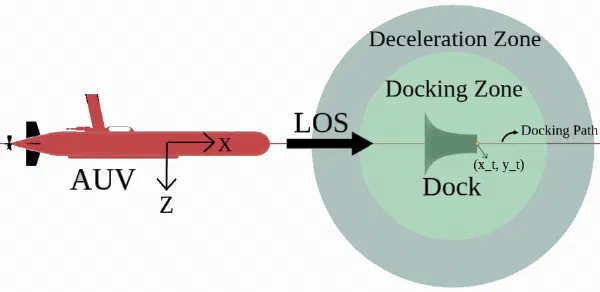
Persistent underwater operations rely on Autonomous Underwater Vehicles (AUVs) to periodically offload data and recharge for extended mission endurance. Autonomous docking presents an effective solution for meeting these operational demands. However, successful docking requires the vehicle to approach the dock at a minimum relative speed to avoid physical damage, while taking the effects of varying ocean currents and vehicle buoyancy into account. In this paper, we pose the docking problem as a path-following problem and propose a novel Polynomial-Logarithmic Adaptive Trajectory (PLATO) law that dynamically prescribes the desired velocity to the AUV while meeting the relative speed constraints. The decoupling of the docking problem into path following and the velocity profile controller enables the generalization of the formulation to accommodate different combinations of path-following algorithms and velocity profile controllers. Simulation results validate the proposed approach, demonstrating its effectiveness across various path-following guidance laws and diverse current conditions.